
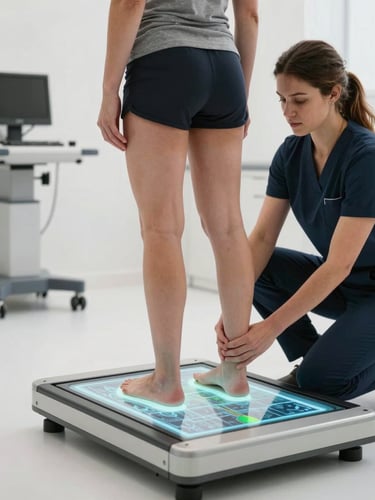
Wide clinical studio frame: Cecilia Borges performing a hands-on gait and foot assessment on a patient standing on a baropodometry platform, viewed from a three-quarter angle — her hands positioned at the patient's hips, analyzing alignment. North-facing daylight, clean shadowless studio environment, anatomically precise framing. The baropodometry platform glows faintly with a pressure-distribution map beneath the patient's feet. Clinical equipment visible in the background. No smiling, no distress — focused, technical.
— Fisioterapia Postural Especializada

A dor não começa onde dói

Avaliação postural, pés e movimento para tratar a causa da dor e reorganizar o corpo de forma integrada.

Close-up top-down view of a baropodometry scan result displayed on a clinical light table — a pressure distribution footprint map in high-contrast thermal color gradient (blue to red), precise and diagnostic. North-facing studio light, no shadows, clinical documentation aesthetic.
Close-up of a thermography scan result showing a human posterior torso in a clinical infrared color map — warm zones highlighted in amber and red against cooler blue-green areas, precise anatomical framing. Flat studio strobe lighting on the display surface, no ambient warmth, clinical documentation style.
Wide environmental shot of an empty postural assessment room: a clinical posture grid mounted on a white wall, precise vertical and horizontal lines visible, north-facing daylight entering from the left, clean shadowless interior. Minimalist clinical setting, no people, architectural discipline.
/ Por que a dor persiste

Muitas dores começam na base do corpo e não no local da dor.

Padrões de apoio e pisada podem gerar compensações ascendentes em joelhos, quadril e coluna.
Por isso, tratar apenas o local da dor nem sempre resolve a verdadeira causa.

A avaliação integra postura, movimento, base plantar e sistema neurossensorial para compreender o corpo de forma global e construir estratégias terapêuticas individualizadas.

Base plantar

Compensações posturais

Estratégia terapêutica

A forma como os pés tocam o chão influencia equilíbrio, postura e distribuição de cargas em todo o corpo. Os pés fornecem informações essenciais para o alinhamento e estabilidade corporal.

Desequilíbrios na base do corpo podem gerar adaptações em joelhos, quadril, coluna e movimento. O corpo cria adaptações constantes para manter estabilidade e equilíbrio.

Cada tratamento é construído de forma individualizada, considerando postura, movimento e função corporal. A reorganização corporal começa com uma avaliação precisa e integrada.

• Método clínico

Diagnóstico biomecânico antes de qualquer intervenção.

O corpo revela padrões antes da dor aparecer.
A avaliação precisa permite intervenções mais conscientes, individualizadas e eficazes.

+500 avaliações realizadas

Análise biomecânica integrada

Atendimento individualizado

Método BASE Postural

Mapeie a origem da sua dor.

A Avaliação Postural Completa entrega um mapa estrutural dos padrões de compensação, desequilíbrios biomecânicos e possíveis causas da dor para direcionar um tratamento mais preciso.

O tratamento correto começa com uma leitura profunda do corpo, não apenas dos sintomas.

O que a avaliação revela

Postura Corporal: Alinhamento global e padrões compensatórios.

Base Plantar: Distribuição de cargas e apoio dos pés.

Marcha e movimento: Estratégias corporais durante o movimento.

Distribuição de cargas: Sobrecargas e assimetrias biomecânicas.

Compensações biomecânicas: Adaptações do corpo para manter equilíbrio.

Equilíbrio e estabilidade: Integração postural e controle corporal.

blue and white striped round textile
an abstract photograph of a curved wall
low-angle photography of blue glass walled building during daytime